Seamless Engineering
P&ID2MTP Generator
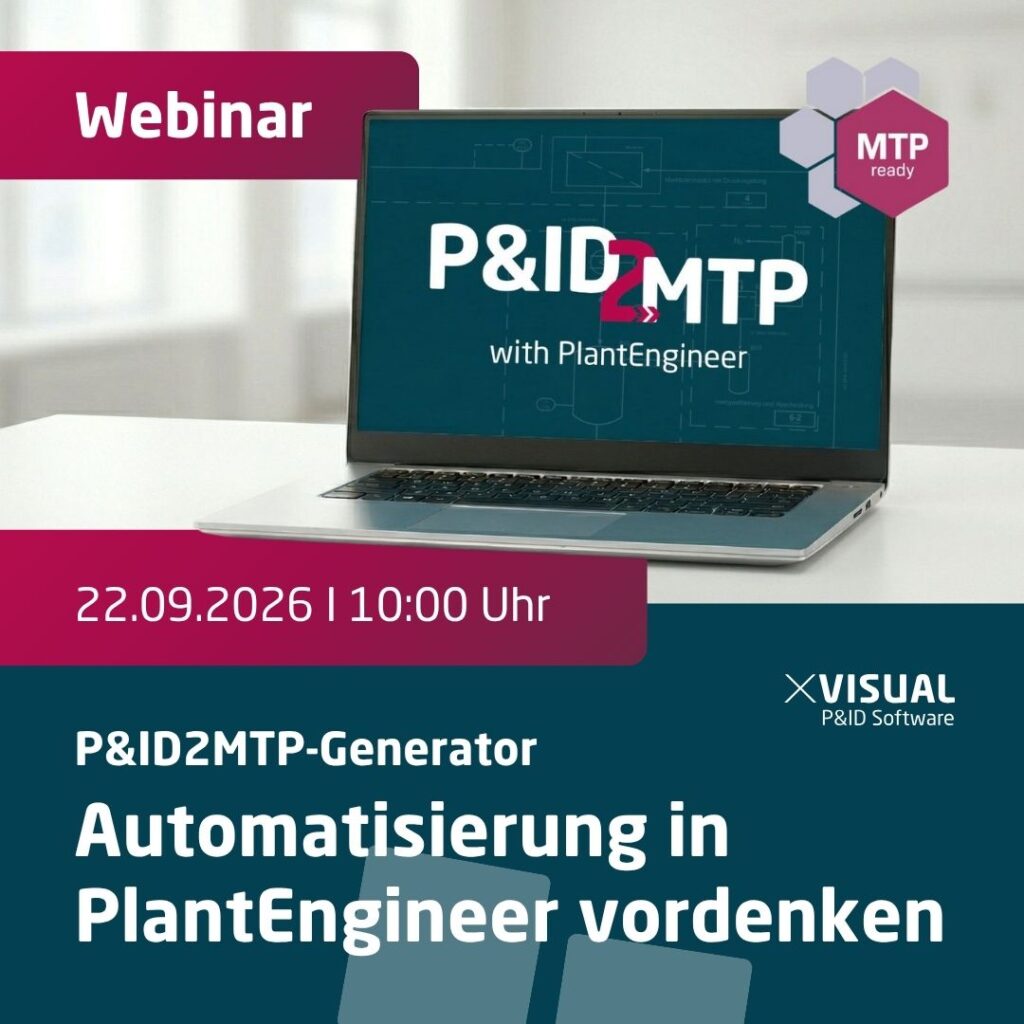
Automation starts within the P&ID: as an integrated feature of our P&ID software PlantEngineer, the P&ID2MTP Generator bridges the gap between process engineering and automation. For the first time, you can define MTPs directly within the P&ID, laying the foundation for true plug-and-produce.

Seamless Engineering
The digital bridge from P&ID to automation
The P&ID2MTP Generator is an integrated premium feature of our P&ID software PlantEngineer, allowing MTPs to be defined directly within the P&ID. It enables seamless engineering by defining services, interfaces, and communication parameters as early as the process design phase.
VDI | VDE | NAMUR 2658 Compliant
Defining MTPs as early as the process design stage
Until now MTP files were created manually by the automation designer. With the P&ID2MTP Generator, this step is already performed during the P&ID design process in accordance with the VDI/VDE/NAMUR 2658 standard. Modular intelligence is defined directly within the P&ID:
- Services & Parameters: Required process functions and their operating parameters are stored directly within the Process Equipment Assemblies (PEAs)
- HMI Interfaces: The visual representation and visibility of components for the subsequent Process Orchestration Layer (POL) are determined during the P&ID stage
- Communication Parameters: Sensors, actuators, and drives are enriched with the necessary information for data exchange between the module control system and the higher-level orchestration system
The result is an MTP containing communication parameters, HMI, and services. This information will be seamlessly integrated into the programming and the POL.
Maximum Efficiency
The P&ID as the single source of truth for your plant design
- No data silos: The P&ID is the “single source of truth.” This reduces gaps between process engineering and automation
- Cost and Time Savings: Early definition significantly reduces the time required for commissioning within the POL. Modules can be implemented faster and more efficiently
- Error Prevention: Standardized module definitions within the P&ID prevent manual transcription errors during programming
- Responsibilities: Process engineers define the requirements, while automation engineers receive data foundation for programming
Turning Standards into Practice
The P&ID as the central information hub
The P&ID2MTP Generator transforms MTP from a theoretical standard into a practical, integrated planning tool. The P&ID becomes a central role for the data exchange in the process engineering and automation design.

P&ID2MTP for your company?
Interested in using the P&ID2MTP Generator in your company? We are here to help you find the perfect solution for your project.
The X-Visual Team is your
specialist for P&ID software
Our areas of expertise
Specialists in P&ID software
Easy-to-use engineering software based on Microsoft Visio for intelligent P&IDs. Create standard-compliant flow diagrams with automatic labeling and technical component data and generate component lists, datasheets, pipe lists directly from the P&ID.
Digital transformation
The P&ID provides the navigation structure for the plant. Thanks to service-oriented interfaces, you connect different software systems and realize the digital thread for the plant. Optimize your business processes, data integration, ERP interface, 3D, electrical systems.
Data standards
Uniform data standards are crucial when implementing the digital transformation. That’s why we collaborate with partners to design standards for data and information exchange such as DEXPI (Data Exchange in the Process Industry) and VDI guidelines.
Bridge-building process technology & automation
We connect the process engineering and automation. The process engineer can plan ahead and visualize the automation requirements through Coloured P&IDs.
Innovation ecosystem
Together with universities and industrial partners, we research the technology of the future, such as modular systems, mixed reality, and artificial intelligence in the process industry.